Your bank’s call center gets a phone call from “you.” Same voice, same little pause before you read off your account number. Except it isn’t you. It’s a cloned version of your voice, pulled together from a 30-second clip someone grabbed off a podcast or a voicemail greeting. That’s not a hypothetical anymore. It happens daily, and that’s basically why agentic AI, Pindrop, and Anonybit keep getting mentioned in the same breath across the security world right now.
If you’ve seen these three names paired up somewhere and weren’t sure what was actually going on, this is for you. Below is what each one does by itself, why people are now talking about them as a single setup, and honestly, where the cracks still show. AgenticAI,Pindrop,and Anonybit
What Is Agentic AI Doing in Identity Security?
Agentic AI means AI that doesn’t just answer your questions but goes and does things on its own, placing calls, joining meetings, moving money, approving transactions, all without someone clicking “yes” at every single step.
That’s useful. It also happens to be a gift for fraudsters. A human scammer can only work one call at a time, get tired, mess up his story under pressure. An AI agent doesn’t have any of those limits, it can run thousands of calls at once and shift its tone the moment it senses someone getting suspicious. That alone is a big reason voice fraud prevention has turned into such a pressing issue for banks, insurers, and contact centers lately.
But agentic AI isn’t only the threat here, it’s also turning into the defense. Rather than just checking a password against a database, a defensive agentic system can watch how someone is actually behaving in real time. Say an account suddenly gets login attempts from five different countries within ten minutes, the system can flag that, demand extra verification, or shut it down, on its own, no human needed to make that call in the moment.
How Pindrop Detects Deepfake Voices in Real Time
Pindrop is basically the ears of this trio. It’s a voice security company, and its whole job comes down to one question: is the voice on this call coming from a real human, or something synthetic?
It works by pulling apart audio for over 1,300 different signals, breathing patterns, tiny acoustic glitches that AI voice tools tend to leave behind without meaning to, the device being used, behavioral quirks, that sort of thing. Within a few seconds of a call connecting, it spits out a liveness score telling the contact center roughly how much it should trust whoever’s on the line.
This matters more than people give it credit for. Several industry reports have pointed to voice fraud attempts jumping well past 1,000% in U.S. contact centers in just a year, with banking, insurance, and retail call centers all getting hit hard. A score by itself won’t stop fraud. What it does is hand every system downstream something solid to react to instead of guessing.
How Anonybit Keeps Biometric Data Out of Reach
Where Pindrop listens, Anonybit stores, except it’s a vault that never actually keeps anything whole in one place.
Most biometric systems shove a fingerprint, face scan, or voiceprint into one central database. Convenient, sure. But it’s also one massive target. Breach that database and every biometric record sitting inside it is compromised, and you can’t exactly reset your own face the way you’d reset a password.
Anonybit goes about it differently. It breaks biometric data into encrypted pieces and spreads them across separate, independent locations. When someone needs to verify who they are, the system checks those pieces without ever putting the full biometric record back together in any single spot. That’s usually what people mean by decentralized biometric authentication, and it happens to fit nicely with privacy rules like GDPR and HIPAA, since there’s never one place holding a complete profile that’s exposed.
Basically: even if someone breaks into one fragment, they still don’t get the whole thing.
How the Three Layers Work Together
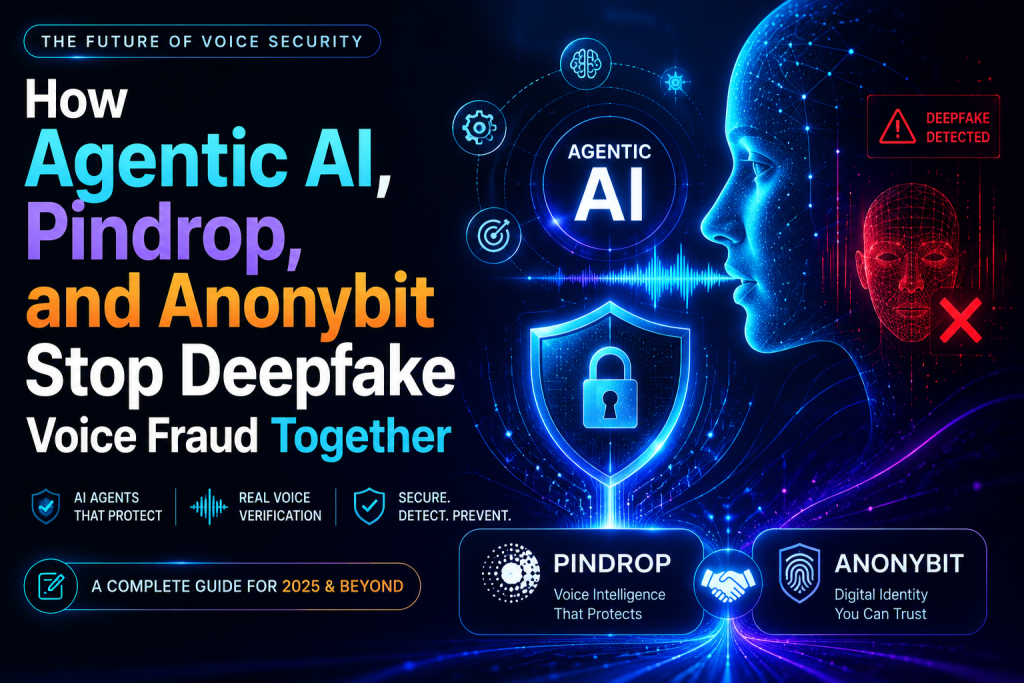
None of these three pieces, agentic AI, Pindrop, Anonybit, handles fraud entirely on its own. Stacked together, though, they cover gaps the others leave open.
Pindrop’s job is figuring out if the voice is real. Anonybit’s job is verifying identity without ever exposing someone’s actual biometric data. Agentic AI takes whatever those two figure out and decides what happens next.
So picture a call comes in and Pindrop returns a shaky liveness score. Instead of dumping that judgment call on a stressed-out human agent, the agentic layer can immediately ask for a biometric step-up check through Anonybit, kick the call over to a fraud specialist, or just end the interaction, all in milliseconds, before anything sensitive gets shared.
This kind of setup fits into a wider shift toward AI identity verification that doesn’t just check a box once at login and forget about it, but keeps watching risk the whole way through an interaction. Some deployments running this layered approach have reported incident response times dropping by more than half compared to older rule-based systems, plus fewer false alarms that lock out genuine customers for no reason.
Where This Framework Matters Most
This isn’t some far-off concept. It’s already being used in places where voice fraud causes real, immediate financial damage.
Banking is the obvious one, a single successful voice-cloning attack on a call center can lead straight to account takeover. Insurance companies are dealing with similar growth, with reports of synthetic voice fraud climbing over 400% in that sector. And contact centers in retail and telecom are picking this up too, since some reports clock fraud attempts there at roughly once every 46 seconds.
There’s a newer use case worth keeping an eye on as well: AI agents acting on a person’s behalf in commerce and meetings. Pindrop has pushed its detection into video conferencing tools to catch deepfakes in live meetings. Anonybit, meanwhile, has been working on tying AI agent actions back to a real, verified human, so an autonomous agent can’t approve a transaction unless an actual living person confirmed it biometrically first.
Where the Framework Still Falls Short
No security setup is perfect, and this one has real weak spots worth knowing about before treating it like a silver bullet.
Liveness detection can trip up on edge cases, bad call quality, heavy accents, or unusual speech caused by a medical condition can sometimes set off false flags. Decentralized biometric systems are harder to breach, sure, but they also bring more complexity and cost than a single centralized database, which can be a real obstacle for smaller companies trying to adopt this. And agentic decision-making is only as sharp as the rules behind it. Tune it badly and it’ll either wave through too much fraud or lock out a bunch of legitimate customers out of pure frustration.
That doesn’t mean the framework isn’t worth using. It just means it works best as one strong layer inside a bigger contact center fraud prevention strategy, not a replacement for trained fraud teams and ongoing monitoring.
Final Thoughts
Voice cloning has gone from science fiction to a regular Tuesday problem for contact centers everywhere. The pairing of agentic AI, Pindrop, and Anonybit is a decent snapshot of where identity security is actually headed: real-time detection, privacy-preserving verification, and autonomous decision-making working together as one system rather than three separate tools bolted on top of each other.
If you’re sizing up fraud prevention options for your own organization, pay attention to how well a vendor’s tools actually talk to each other, not just how impressive any one feature looks in a sales demo. A detection engine without a fast decision layer behind it is just a warning light nobody gets to in time.