Three years ago, this was a research curiosity. Now it’s in your phone, your IDE, your hospital’s records system. Large Language Models (LLMs) did not gradually sneak into the mainstream; they arrived all at once and started rewriting assumptions about what software is capable of. Contracts are summarized in under a minute. Code generated from a sentence. Conversations that don’t feel like talking to a search engine. All of it from the same family of technology.
The question worth asking isn’t “what can these do?” that list keeps growing. The more useful question is what’s actually happening under the surface. How does a machine read your question and hand back something that sounds like it genuinely understood you? That’s what this piece is about.
What Is a Large Language Models?
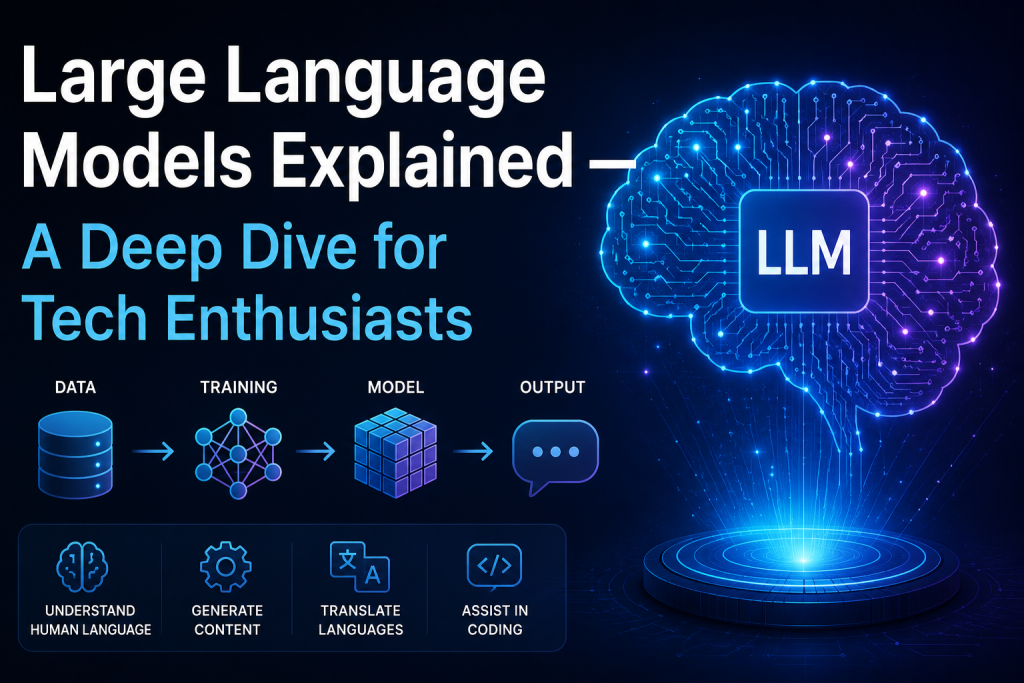
Pull back the curtain and an LLM is basically an AI that got fed text a truly staggering amount of it until it figured out how language works. The word “large” is pulling double duty here: it covers how much data got poured in, and how many parameters live inside the Large Language Models. Parameters are weights, just numbers, and collectively they’re what make the model respond the way it does.
sufGPT-4 reportedly has hundreds of billions of them. During training, those numbers get nudged over and over until wild guessing stops and pattern recognition kicks in, sentence structure, factual associations, coding conventions, what a logical argument actually looks like versus a mess of words pretending to be one.
At rock bottom, the whole thing runs on one trick: guess the next word. Give the Large Language Models some text, it picks the most probable next token, repeat. Chain that long enough and what comes out often reads like someone who was actually paying attention.
The Architecture Behind LLMs: The Transformer
Every real Large Language Models today runs on the Transformer. A team at Google dropped it in 2017 in a paper titled “Attention Is All You Need,” and that’s pretty much all it took — the whole field pivoted.
Before that, the standard tool was Recurrent Neural Networks. RNNs moved through a sentence one word at a time, the way you’d read something aloud at a slow pace. Short texts? Manageable. Anything longer, and by the time the model reached the end, it had often lost the thread from the beginning. Transformers ditched that approach completely. Instead of step-by-step, every word in a passage gets processed at the same time and something called self-attention handles the job of figuring out which words relate to which.
Self-Attention: The Engine of Understanding
Here’s a concrete way to see what self-attention actually does for Large Language Models. The word “bank” could mean a riverbank or a financial institution. The word itself doesn’t tell you. But in the sentence “The bank by the river was flooded,” the word “river” is sitting nearby and changes everything. Self-attention catches that pairing, weights it heavily, and the model lands on the right reading without being told to look for it.
Zoom out to full documents keeping track of which “he” refers to which person three paragraphs back, which clause belongs to which argument, what an earlier sentence was setting up and you get a sense of why this mattered. Earlier architectures just couldn’t hold that much context reliably.
Key Components of the Transformer
Tokenization — Text doesn’t walk in as raw words. First, it gets chopped into tokens whole words sometimes, fragments other times, occasionally a single character- for Large Language Models. Every token turns into a numerical vector called an embedding that carries what the model knows about its meaning.
Positional Encoding — Processing everything at once has a side effect: the model forgets what came first. Positional encodings are numbers added to each token’s embedding that stamp it with its position, “dog bites man” and “man bites dog” look identical.
Multi-Head Attention — The Transformer doesn’t run one attention pass. It runs several at the same time, each looking for something different. One might track grammatical roles. Another might connect thematically related words. A third might be doing something harder to name. The results all get folded together at the end.
Feed-Forward Layers — Once attention has finished, each token’s updated representation moves through a small neural network that does further processing. More patterns get baked in here.
Layer Stacking — This whole process doesn’t run once. It runs across dozens or hundreds of stacked layers. The early ones handle surface stuff — punctuation, common word pairings. The deeper ones are working with abstractions that bear no visible resemblance to the original words. By the time information reaches the final layer, it’s been transformed into something the model built entirely for its own use.
How Large Language Models Are Trained
This is not a weekend project. Training a current frontier model means thousands of GPUs running flat out for months, eating through datasets bigger than any human could read across multiple lifetimes.
Stage 1: Pre-Training6
Pre-training is the expensive part of LLM, the real foundation. The model gets fed web pages, books, academic papers, code, Wikipedia, Reddit, whatever — and its only job is to predict the next word in a sequence.
Sounds almost too simple to work. But to pull that off reliably across billions of sentences from wildly different sources, the model has to quietly absorb an enormous amount along the way: how sentences are put together, which claims tend to be true, why certain words follow others, what working code looks like versus broken code, how an argument builds versus how it falls apart Large Language Models. None of that was programmed in. It all had to be picked up as a side effect of getting the prediction task right. And with enough data and enough compute, it sticks.
Common Crawl, Wikipedia, GitHub, and various curated book collections are the usual building blocks.
Stage 2: Fine-Tuning
Fresh out of pre-training, the model is knowledgeable but directionless. Ask it something, and it might just keep rolling with whatever style it was in rather than actually answering. Fine-tuning fixes that by running the Large Language Models through hand-picked examples of exactly what you want it to do, Large Language Models answering clearly, following through on instructions, and giving a straight summary. It’s how the model learns that “helpful” is the goal, not just “plausible.”
Stage 3: Reinforcement Learning from Human Feedback (RLHF)
Even after fine-tuning, the model doesn’t always land on what people actually want. RLHF is the step that closes that gap. Human raters look at pairs of responses and mark which one is better. Those choices get used to train a separate reward model Large Language Models a system that learns to predict what a human reviewer would prefer. Then the main model gets updated to score higher on that reward.
ChatGPT, Claude, Gemini — this is the step that gave them their personalities and their ability to stay on track. Pre-training gave them knowledge. RLHF gave them usability.
Context Windows: The Memory of an LLM
Context window is the term for how much text a model can hold in mind at one time. Think of it as short-term memory — once something drops out of the window, it’s gone, as if it never existed.
GPT-2 topped out at about 1,000 tokens — roughly 750 words. That was already a limitation. Today’s numbers look completely different:
| Model | Context Window |
| GPT-4 Turbo | 128,000 tokens |
| Claude 3 Opus | 200,000 tokens |
| Gemini 1.5 Pro | 1,000,000 tokens |
At 200,000 tokens, a whole novel fits comfortably. At a million, you can drop in a full codebase. The model reads all of it and can reason across any part of it — find a clause buried 180 pages into a contract, trace how a variable changes hands through fifty interconnected files. That was genuinely impossible with older context limits. Now it’s routine.
Emergent Capabilities: When Scale Unlocks Intelligence
Something nobody fully predicted kept happening: certain capabilities simply didn’t exist in smaller Large Language Models, and then past some size threshold, they just showed up. Not gradually. Not incrementally. They appeared.
Researchers call these emergent capabilities, and a few of the notable ones:
Chain-of-thought reasoning — A small model handed a multi-step problem usually skips the steps and guesses. A large model told to “think it through” will actually work the problem in sequence. The jump in accuracy on math and logic tasks once this kicks in is significant, not marginal.
In-context learning — Drop a few worked examples into the prompt and a large model often generalizes the pattern and runs with it. No weight updates, no retraining. Just examples in the input and the model figures out the rest.
Code generation and debugging — Full working functions from natural language. Explanations of what unfamiliar code actually does. Catching logical errors a human reviewer might miss. Across a long list of Large Language Models.
Mathematical reasoning — Word problems, symbolic algebra, proof-checking. Nobody specifically trained for these. They came anyway.
Nobody has a clean answer for exactly why emergence works the way it does. The honest answer is: scale seems to unlock it, and we don’t fully know why.
Real-World Applications of LLMs
Adoption cut across industries faster than most forecasts had it:
Software Development — GitHub Copilot, Cursor, and a handful of similar tools have changed what the daily work of coding actually looks like. You describe what you need, working code comes back. Paste in something unfamiliar and ask what it does, you get a plain-English explanation. Point to a bug, it tells you where the logic breaks. Developers who get used to working this way tend to stay that way Large Language Models going back just feels unnecessarily slow.
Healthcare — The paperwork load in clinical settings is crushing. Documentation, literature synthesis, diagnostic assistance, patient-facing messages — Large Language Models are being used to take on the parts that don’t require actual medical judgment, freeing up clinicians for the cases that do.
Legal and Finance — Digging through 200-page contracts for the relevant clause, pulling together a body of case law, drafting a financial summary from raw numbers. Work that kept associates busy for days now takes hours. The firms using these tools aren’t going back.
Education — When an explanation doesn’t land, the model tries another angle. Practice problems aren’t recycled from a fixed set — they’re built fresh, tuned to where you actually are. And it’s available whenever you’re working, not just during office hours.
Scientific Research — Literature reviews that used to take months now take days. Hypothesis generation, early-stage drug screening, protein analysis, LLM researchers with small teams are covering ground that would’ve needed much larger ones before.
Key Challenges and Limitations
None of this is without real problems. Some are engineering challenges. A few are more fundamental.
Hallucinations
LLMs don’t look things up. They generate what seems likely to come next based on patterns. Large Language Models and “likely” and “accurate” aren’t the same thing. When the model’s patterns converge on a confident-sounding output, it produces it. There’s no internal alarm that fires when something is wrong. So you get fabricated citations, invented dates, wrong figures — delivered in the same tone as anything that happens to be correct.
RAG — retrieval-augmented generation LLM is the main practical workaround right now. It pulls content from verified sources before the model generates its response. The hallucination rate drops considerably. The problem doesn’t disappear.
Bias and Fairness
LLMs absorb what’s in the training data. The internet and published books carry decades of embedded assumptions about gender, race, geography, religion. Those patterns get learned too. They show up in outputs in ways that range from faint to glaring. Spotting the bias is hard. Reducing it without breaking other things is harder. Nobody’s cracked this cleanly.
Computational Cost
Training at the frontier level costs tens of millions of dollars and burns through energy at a rate that’s hard to defend on sustainability grounds. That keeps the most capable models in a small club of well-funded organizations. The efficiency side of the field — quantization, distillation, sparse architectures Large Language Models is making real headway, but training from scratch is still beyond reach for most teams.
Safety and Alignment
Getting a model to do what you asked is one thing. Getting it to do what you actually needed — including in cases you didn’t anticipate — is something else. The gap between those two grows as models become more capable. Every major lab has safety researchers now. The field is real and moving. The problems aren’t solved.
The Road Ahead: What’s Next for LLMs
A few directions that are clearly already in motion:
Multimodal Models — Staying text-only was always a bottleneck, not a choice. GPT-4o and Gemini Ultra handle images, audio, and video. The direction is toward systems that process multiple input types together, not sequentially — closer to the way a person actually engages with the world.
Agentic AI — The shift is from “answer my question” to “here’s what I need done.” Large Language Models slotted into agentic pipelines can browse the web, execute and debug code, manage files, and string together multi-step tasks without step-by-step human direction. Early versions are shipping. Better ones are in the pipeline.
Smaller, More Efficient Models — Frontier scale is genuinely unnecessary for most tasks, and most organizations can’t get near it anyway. Real effort is going into smaller models that keep most of the useful capability and run locally — on a decent laptop, on a phone. Getting serious AI out of the cloud entirely is the end goal.
Long-Term Memory — Right now, every conversation starts from scratch. Nothing carries over. The model meeting you for the hundredth time knows as much about you as it did the first. Persistent memory Large Language Models holding onto context and history across sessions. Large Language Models is being built into products now, and the first working versions are already out there.
Conclusion
LLMs have already changed how software gets written, how research gets done, how legal teams work, how students study. That’s not a projection, Large Language Models, it’s already happened. And what’s running now is an early version of something still moving fast.
Knowing how these systems actually work changes your relationship with them. Understanding what a Transformer does, what RLHF is correcting for, where hallucinations come from, what context limits mean in practice Large Language Models that’s the difference between using a tool and being used by one.