Okay so everyone’s talking about “AI agents” now. Wasn’t it AI assistants like six months ago? Did the tech actually shift, or did marketing just find a shinier word?If you’ve spent any time online lately, you’ve probably noticed everyone suddenly talking about “AI Agents vs AI Assistants.” Six months ago, it was all about AI assistants. So what changed? And more importantly, are these two things even different, or is it just marketing dressed up in a new outfit?
Here’s the short answer: yes, they’re different. And once you see the difference, a lot of the confusing AI talk you’ve been scrolling past will finally click into place.
It actually shifted. Once you get this one thing, half the confusing AI Agents vs AI Assistants talk online suddenly makes sense.
What Is an AI Assistant, Really?
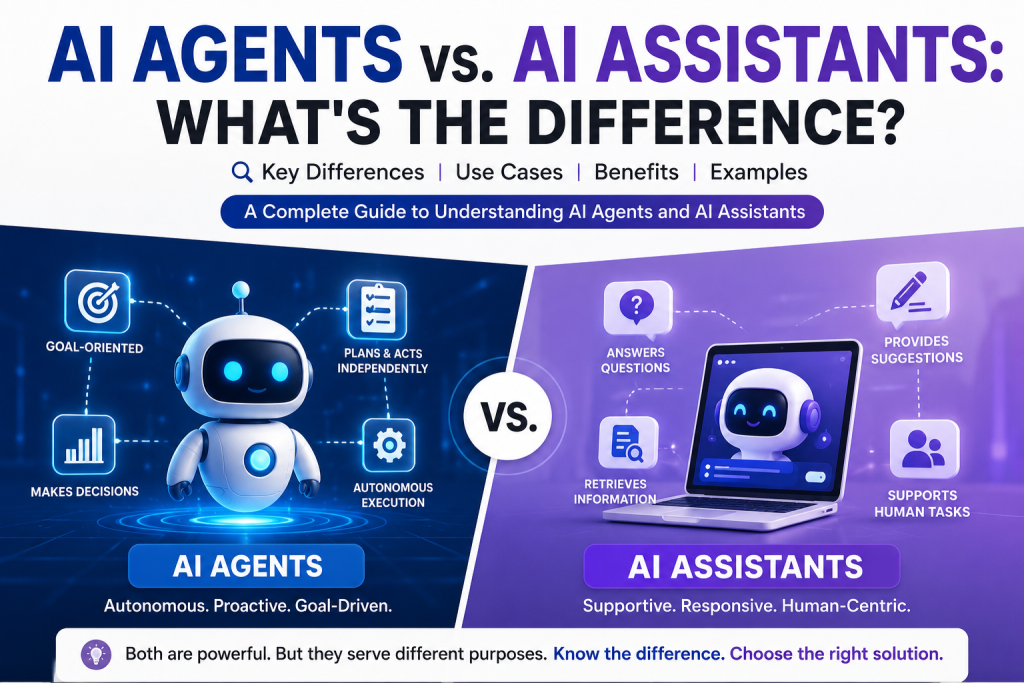
Think of a helper who’s good at their job but won’t move until you say something. You ask, it answers. Want an email written? It writes one. Need three paragraphs turned into three sentences? Sure, done.
ChatGPT, Claude, Gemini, in their regular chat form, that’s all this category. They react to you. They’re not off doing random stuff you never asked for, and honestly that’s kind of the point of them. You’re driving, every single time.
Which is totally fine, by the way, because this is where most people actually live day to day. Need a rough outline for something you’re writing? Ask. Paragraph reads clunky? Ask again. The whole setup works because you’re calling the shots and it’s just along for the ride, helping you go faster.
What Is an AI Agent, Then?
An agent does more than answer. Give it a goal and it’ll work through a bunch of steps by itself, and you don’t have to stand there watching every single one.
Say you want pricing pulled from five competitors into a spreadsheet. With an assistant you’re asking piece by piece. Give that same job to an agent and it’ll go look stuff up, pull what it needs, organize it, and just hand you a finished thing. No extra typing on your end.
That’s really the split here. Assistants sit and wait for you AI Agents vs AI Assistants. Agents get up and go do it. There’s some independence wired into how they work, picking which tool to use, deciding the next move, pushing toward whatever goal you handed them.
Why Does This Distinction Matter for You?
You might be sitting there thinking, why should I even care. Fair, honestly.
Pick the wrong tool, you waste time. Trying to automate something repetitive, sorting leads, building a weekly report, an assistant just can’t keep pace. You’ll be typing new instructions every five minutes, which kind of kills the whole reason you wanted automation. An AI Agents vs AI Assistants , even a simple no-code one, is where the actual hours get saved.
But not everything needs an agent strapped to it. Just want to brainstorm, or fix a clunky sentence? An assistant’s faster, simpler, and a bit safer too, since agents running solo can wander off course if you didn’t set things up tight from the start.
Know which one the job actually calls for, and you stop either overbuilding something tiny or trying to muscle a big task through with the wrong tool entirely.
Real-World Examples to Make This Click
Couple of everyday moments:
- Assistant scenario: You ask Claude for a product description. You read it, ask for changes, use the final thing. You’re hands-on, start to finish.
- Agent scenario: You build a Zapier or Make flow watching your inbox, it tags incoming questions, drafts a reply, follows up on its own if nobody answers in 48 hours. Build it once, it just keeps running.
See it? An assistant’s a conversation. An agent’s a thing you set up and walk away from.
Can They Work Together?
Yep, and honestly this is the fun part. Loads of real setups blend both. Use an assistant to figure out the plan, hand the actual grunt work to an agent.
This ties into something way bigger happening right now across AI Agents vs AI Assistants, a move from “tool that helps once” toward “coworker that takes whole chunks of work off your plate.” Heard the term agentic AI floating around? That’s exactly this, groups of agents working together on bigger goals instead of one assistant doing one task at a time.
So Which One Do You Actually Need?
Quick gut check, here goes. One question, one piece of writing, one decision you’d rather make yourself? Assistant. Less setup, less to manage. AI Agents vs AI Assistants
Doing the same multi-step thing every week, like clockwork? That’s your sign to look at an agent. And no, you don’t need to code anything, tools built for regular people have made this way easier than it sounds.
Most beginners start out chatting with an assistant, get comfortable, then eventually spot some repetitive task worth handing off. No rush to jump to agents just because it’s the buzzword of the moment.
Final Thoughts
The gap between agents and assistants isn’t word games, it’s a tool that talks versus a tool that actually does the work. One’s your thinking partner. The other’s the one executing.
Figure out which task in front of you needs, and the whole AI Agents vs AI Assistants landscape stops feeling like a lot. Start with what fits today; add the other piece whenever you’re ready.
Want to see an AI agent in action? Check out our beginner’s guide to building your first one with no-code tools like Zapier.